Annual Publications
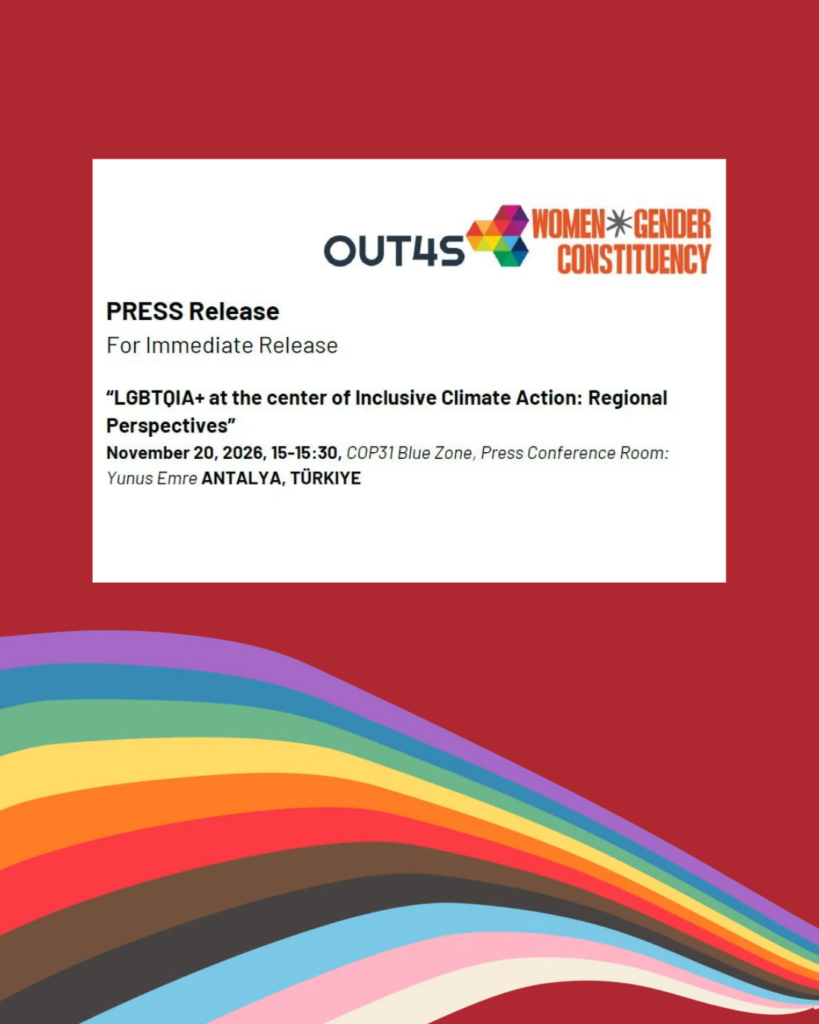
Press Conference: November 20, 2026, 15-15:30, COP31 Blue Zone, Press Conference Room: Yunus Emre
Lifestream and recording available here.
The Queer Intersectionalities Working Group of the Women and Gender Constituency and WGC member, OUT for Sustainability, marks on this last day of COP31 as a moment of immense importance to center the voices that have been either been intentionally left out of climate movements or risk their safety and security due to repression.
Media Contacts:
OUT4S: Diego de Leon [en/es]
WGC: Sinéad Magner [en/fr]
16/11/2026
18/11/2026
On November 20th, advocates and experts from the Pacific, Latin America and the Caribbean and around the world will center and ground their work in the UNFCCC process, through new data and growing coalitions.
As International Allies from across the Queer Climate Justice Movements, we stand in solidarity with Turkish LGBTQIA+ activists that should be at this table, and they are not as a direct result of their recent and violent persecution. As we engage in an international fora; we respect their decisions about how, when and whether to be visible, and we will not speak over them or put them at risk for a headline. They have done this work long before COP31 arrived and will keep doing it after it leaves. Our job is to follow their lead on what support they need, and to keep that support going once the cameras are gone.
Likewise, Pacific queer communities are living the climate crisis now, and they know what works. They are leading community responses on the ground and any COP that claims to put the Pacific at its center must hear from all of the Pacific, especially its queer communities.
This year brought real challenges and real progress. The Belém Gender Action Plan was adopted at COP30 amid coordinated attempts to dilute human rights language and reduce gender to binary terms. Civic space for LGBTQIA+ defenders has narrowed in many countries. Few governments collect data on LGBTQIA+ people, so their climate risks largely go uncounted. Even so, the movement has grown since the Bonn climate talks in June. LGBTQIA+ advocates have brought queer climate concerns to the Commission on the Status of Women, the High-Level Political Forum, disaster risk reduction spaces and the UN General Assembly. Within the UNFCCC, they have widened their engagement to finance, adaptation, and loss and damage. In Mexico, LGBTQIA+ communities were consulted directly in the national adaptation plan process, and the country’s latest national survey on sexual orientation and gender identity included a question on climate-induced displacement. Looking ahead, the national assessments under the Belém Gender Action Plan give countries a chance to count queer communities in their climate policies. OUT for Sustainability and its partners are also building the SOGIESC Climate Alliance, which they hope to launch in June 2027.
The work of the global working group now moves to implementation: the Belém Gender Action Plan, national adaptation plans and NDCs, and the road to COP32. We invite governments, UN bodies and funders to work with LGBTQIA+ organizations as partners from the start, not as an afterthought.
16/11/2026
18/11/2026