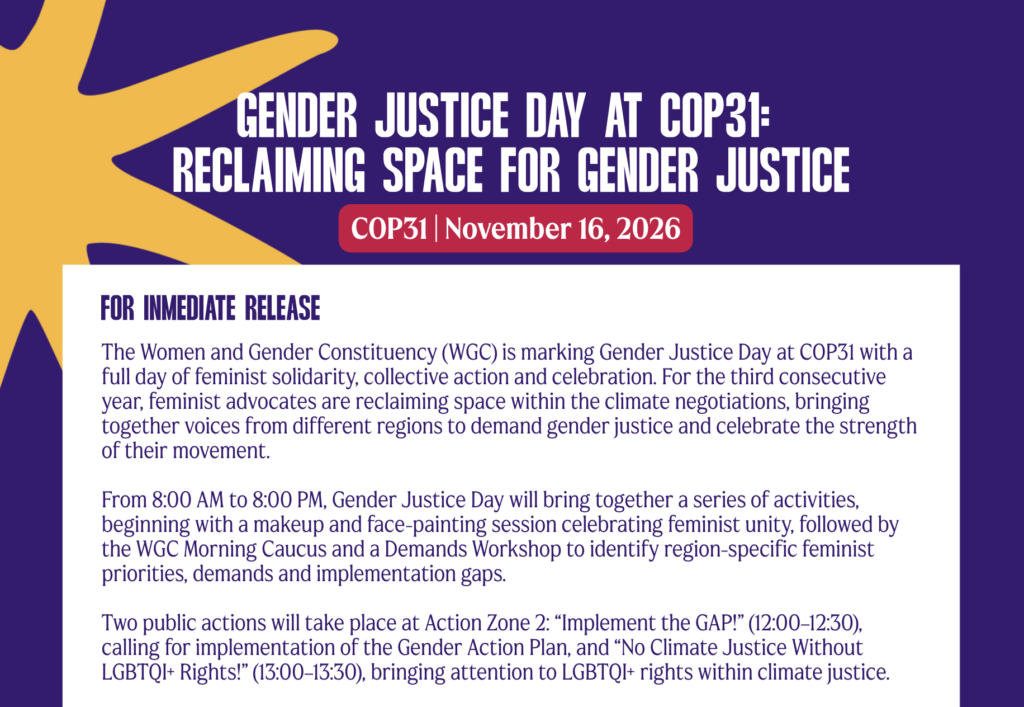
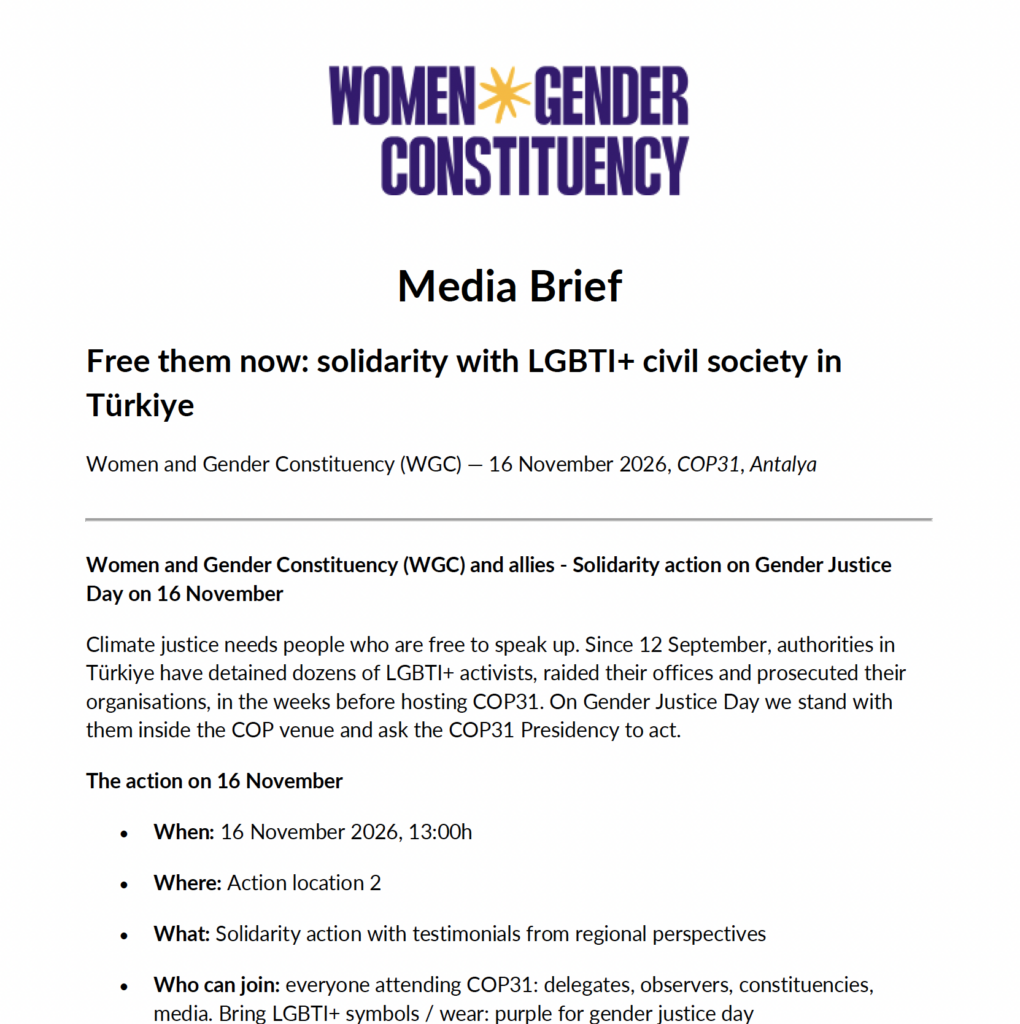
Press Release: Gender Justice Day at COP31: Reclaiming Space for Gender justice
16/11/2026
Developed countries commit just US$50 million at a key moment for the Adaptation Fund, and UNFCCC constituencies and allies call on developed countries to fulfill their obligations.
Media Contact: tara@wedo.org, 1-931-206-4735
On Tuesday night, during crunch time for negotiations in Antalya, where the call to triple adaptation funding is front and center, the Adaptation Fund held its annual high-level contributor dialogue. This was an opportunity for contributors to this vital Fund to announce their commitments to supporting grant-based climate finance for urgent adaptation actions — and show good will towards an ambitious Antalya outcome. This vital support did not arrive. Instead, the handful of pledges announced were not only shamefully short of what developing countries need, but the US$50 million amounts to only one sixth of the already painfully modest US$300 million annual resource mobilization floor the Adaptation Fund has set. This was yet another sign that developed countries are turning their back on their obligation to deliver adaptation finance under the UNFCCC and the Paris Agreement.
The Adaptation Fund is the only multilateral climate fund providing full-cost grant financing exclusively for adaptation to all developing countries. As the pioneer of direct access, it is a unique and necessary fund in the climate finance architecture, nimble and responsive to developing countries, with particular pathways and a focus on gender-responsive, locally-led climate action and with capacity support for direct implementing partners from developing countries, including from non-governmental organizations.
During Tuesday evening’s event, only three contributors — Spain, Germany, and Ireland — announced pledges that, when added to previous pledges from Estonia, Portugal, and Belgium’s Brussels region, which were not present at the event, total US$50 million. This is an abysmal showing at COP31, where scaling up delivery of adaptation finance is a central demand of campaigners and developing countries. Rather than a one-time fluke, this marks the fourth consecutive year in which developed countries have pledged amounts far short of the Fund’s resource mobilization target, set at a minimum of US$1.2 billion for 2026-2029 by the Board.
The imperative of grants-based climate finance delivery is reaffirmed by the recent UNEP Adaptation Gap report, estimating adaptation finance needs at around US$305 billion per year by 2035, or US$420 billion if inflation is factored in, and finds that even full delivery of the tripling of adaptation finance called for by governments at COP30 would cover only 20 to 29% of needs.
With this incredibly small number of contributors and such meager contributions, the Adaptation Fund will be unable to meet the growing demand from its national, regional, and international access entities, which have submitted record funding requests totaling almost US$2 billion. These proposed projects are designed to meet the needs of communities, workers, and marginalized groups, including Indigenous Peoples, at the frontline of the climate crisis.
While the pledges from Spain, Germany, Ireland, Portugal, Estonia, and Brussels are appreciated, they drastically underdeliver what is needed and what is mandated. All developed country Parties
have an obligation to support adaptation action, a key goal of the Paris Agreement, and many of these governments are capable of scaling up their contributions to meet the needs. Especially given the clarity of the science on the needs gap and the recent decisions in the UNFCCC space, such as the new collective quantified goal, this abominable abdication of responsibility is incompatible with developed countries’ professed commitments to climate finance and climate action overall.
As people’s lives have been cast aside, livelihoods dismissed, biodiversity and ecosystems forsaken, we call on all developed countries that have not yet pledged to do so before the close of COP31. How and when the tripling of adaptation finance is delivered will matter as much as whether it is delivered. A significant share must flow through grant-based, directly accessible channels such as the Adaptation Fund.
____________
This is a joint press release by the rights-based constituencies of the UNFCCC — the Women and Gender Constituency, Climate Action Network, The Global Campaign to Demand Climate Justice, Indigenous Peoples Organizations, YOUNGO, the children and youth constituency, and TUNGO — and the Disability Caucus and the Health community.