
Back
SB64 Outcome Statement: Feminists are Fighting, but Delay and Distraction are Marking this Process
Related Resources
Press Releases
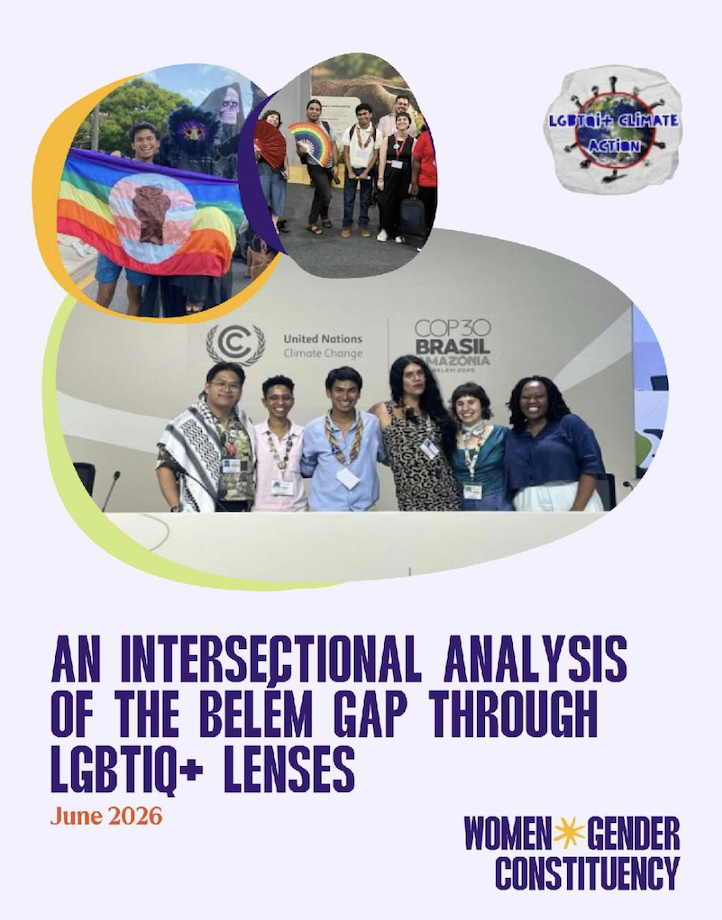
Press Release: Queer Intersectionality in Climate Justice
09/06/2026
Queer Intersectionalities Media Advisory SB64
The Subsidiary Bodies Meetings (SB) are intended to be the space where Parties send their technical experts to work collaboratively, advance substantive discussions, and build agreement on the actions needed to address the climate crisis. We once again witnessed a troubling display of power politics and the manipulation of the consensus model to protect the interests of a few at the expense of the many.
The WGC reminds Parties that the ultimate objective of the Convention is to prevent dangerous (human) anthropogenic interference with the climate system. Parties should be working collectively to raise ambition toward achieving this goal, not obstructing progress, delaying action, or undermining trust in the multilateral process.
At SB64, we saw adaptation and technology negotiations effectively held hostage by procedural maneuvering. We witnessed continued delaying tactics on just transition discussions, despite the urgency of ensuring equitable pathways away from fossil fuel dependence. We also saw climate finance increasingly reduced to a series of dialogues, workshops, and events rather than concrete commitments, delivery mechanisms, and accountability measures. These approaches do not respond to the scale or urgency of the climate emergency we are facing.
Across the Global Majority Countries, economies are struggling to withstand escalating climate impacts. Communities are losing livelihoods, people are losing their lives, and inequalities within and between countries continue to deepen. Women, Indigenous Peoples, workers, smallholder farmers, youth, persons with disabilities, and other marginalized groups are bearing the heaviest burdens of a crisis they did little to create. Yet some Parties continue to treat climate negotiations as a stage for geopolitical positioning and political gamesmanship rather than a forum for collective problem-solving.
Such actions are unacceptable. Every delay in decision-making has real-world consequences for communities already living on the frontlines of climate change. Every procedural obstruction weakens confidence in the multilateral process and widens the gap between political commitments and lived realities.
The climate crisis demands urgency, solidarity, and genuine cooperation. Parties must move beyond narrow national interests and demonstrate the political will necessary to deliver meaningful outcomes on adaptation, finance, technology transfer, and a just transition. The credibility of the UNFCCC process depends not on the number of dialogues held, but on the concrete actions taken to support people, protect ecosystems, and advance climate justice.
A detailed thematic reflection of the SB64 outcomes is provided below.
Topline Analysis of Key Outcomes
Adaptation
The adaptation negotiations in SB64 has once again revealed that the technical work to advance the Global Goal on Adaptation is inseparable from the political will to provide accessible and equitable finance to those communities most in need. As WGC, our emphasis remains on ensuring that gender and inclusion is an integral component of the global adaptation indicators. Women and gender groups bear the brunt of climate change impacts every single day. Their knowledge and experience must shape the indicators. We also know that no indicator framework or national adaptation strategy can be implemented by developing countries if the much needed financial and capacity support is not provided by developed countries. We therefore call on Parties to resolve the deadlock on the tripling of adaptation finance commitment under the Global Goal, and take decisive steps to ensure the transition of the Adaptation Fund to serve the Paris Agreement.
We are far behind on giving communities, women in all their diversity, and youth a chance to build the safe future they so much deserve. Swift implementation was the COP30 promise, we should not let it die a swift death already before we reach COP31.
Just Transition
We welcome that Parties have been able to agree to this draft text. In its current form, this text will not deliver something strong for just transition if Parties simply set this aside and pick it up again in Antalya. We urge Parties to use this time between now and COP31 to work together, build consensus, address the sticky issues, and to arrive in Antalya with a strong basis to agree on an ambitious mechanism that delivers justice for the people, workers and communities on the frontlines of the transition. We call on the Presidency to ensure that Parties and non-Parties have enough time and space to discuss, engage openly, and develop the text.
As feminists, we stand with our comrades from other rightsholder constituencies – trade unions, environmental groups, youth and Indigenous Peoples – in demanding a Just Transition decision at COP31 that turns just transition from rhetoric to reality.
UNFCCC Reform
At the Women and Gender Constituency, we have been asking ourselves what our true vision is of a democratic, equitable, and decolonial feminist multilateral system. The call is spreading like embers to a flame, quietly but sturdily growing. Collective frustration is becoming harder to suppress—fueled by stalled climate action, worsening crises, perpetuated structural injustices, and colonial legacies sustaining unequal power relations, and, in turn, social, economic, and climate burdens among civil society, feminists, and the Global Majority. It is time to address the elephant in the room and think beyond reform towards transformation. The UNFCCC, a multilateral space mandated to deliver on climate action, has slowly transformed to a breeding ground for corporate capture, colonial greenwashing, and false solutions. We are supporting and echoing the calls for a dedicated time and dynamic space to address the root causes of ineffectiveness, inequity, and injustice—not through reductionist solutions, but radical and transformative approaches.
Gender
SB64 was the first major milestone after the adoption of the Belém Gender Action Plan at COP30 (Decision 7/CP.30). At SB64, we saw the GAP come to life through its mandated events, including the expert dialogue on gender and age-disaggregated data, workshop on the role of the national gender and climate change focal point, and the first annual gender-responsive climate finance dialogue. We welcome the active engagement of Parties in these mandated events, and urge for an even more intentional implementation of the Belém Gender Action Plan, one that centers the communities most affected by the climate crisis and at a national-level through adequate resources, accountability mechanisms, and meaningful, safe participation. Now, our eyes turn to the next significant milestones: national assessments on gender and climate change matters (including care, health and violence against women).
Finance
The climate finance talkshops in Bonn did not respond to the urgency of an ever-escalating climate crisis but instead underscored the lack of commitment and action by developed country Parties to provide public, accessible, grant-based climate finance that is essential to implementing gender-responsive climate action. The only actual negotiations, on the Adaptation Fund, further revealed Parties’ larger efforts to renege on their promises and legal obligations, particularly when adaptation finance should be at least tripled in coming years. Meanwhile, at the first annual dialogue with the multilateral climate funds on gender-responsive climate finance, a key deliverable of COP30’s Belém Gender Action Plan, funds merely reiterated their existing programming instead of engaging more generatively, informed by their fundamental responsibility to ensure climate finance delivers real outcomes for people of all genders subjected to climate change’s destruction of their livelihoods, landscapes, and lives. We demand that the public provision of climate finance take its rightful place at COP31 with an agenda item on the Article 9 work programme.
Global Stocktake
The barriers to implementing the Global Stocktake are not technical — they are political. We see that global military spending has hit 2.88 trillion dollars in 2025, while at the same time Pacific SIDS face a tenfold renewable energy finance gap and LDCs cannot meet their 2030 targets for lack of financial, technology and capacity building support. The dilemma is not scarcity — it is allocation. Delaying (or denying) access to affordable means for NDC and NAPs implementation, and to address loss & damage, will only lead to more destruction and conflicts. The Women and Gender Constituency is here to say: « finance, and decision-making power must reach women, girls, gender-diverse people, Indigenous Peoples and frontline communities, including Women Environmental and Human Rights Defenders, as right-holders, based on their lived knowledge – and this must be a priority.
Technology
When discussing implementation, we must necessarily address technology. Negotiations at SB64 were highly contentious, putting climate action in Global Majority countries at risk. Today, we welcome the fact that the Parties reached an agreement ensuring the continuity of the mechanism and its implementing body, the CTCN. However, we remain concerned about the level of trust within the room and the wounds opened over these past two weeks. We hope the Presidency is committed to supporting and collaborating on the continued strengthening of the technology mechanism through the operationalization of the TIP and the new CTCN host. For its part, the Women & Gender Constituency will continue to advocate for the development and transfer of climate technology to Global Majority countries to be carried out with a gender-responsive approach, promoting local knowledge and protecting the rights of Indigenous Peoples.
Agriculture
It has been a frustrating session with SJWA. The references to agroecology have been removed from the text despite it being one of the few proven approaches capable of strengthening climate resilience in food systems, reducing the harmful impacts associated with industrialised agriculture. At the same time, the current text increasingly reflects the priorities of large agribusiness interests, including the use of vague or unscientific terms such as “climate‑smart agriculture,” and a strong emphasis on technological solutions that risk widening existing inequalities.
We demand that the text explicitly recognize women’s land and resource rights as a foundation for climate resilience. We urge Parties to recognize agroecology as a holistic and transformative pathway for agricultural sector transformation that advances the right to food, food sovereignty, climate action, biodiversity protection, and social justice. gender-responsive and locally accessible climate finance, women, Indigenous, gender diverse, youth leadership and decision-making in agriculture and food systems governance, collection and use of gender-disaggregated data, unpaid care and domestic work, which often increases during climate shocks and undermines women’s adaptive capacity.
Action for Climate Empowerment
As WGC leaves SB64, we do so with determination and a clear sense of purpose. The outcome taking shape through this midterm review provides a strong foundation for advancing Action for Climate Empowerment, and we will continue working to ensure its ambition is maintained and strengthened. ACE reminds us that climate action depends on access to information ,education,training,public participation, public awareness and international cooperation because people cannot contribute to solutions if they are excluded from knowledge and decision making. We know that climate solutions are stronger when they are shaped by the people living the realities of the climate crisis every day, especially women,gender diverse people, Indigenous Peoples, people with disabilities, grassroots communities and those too often excluded from decision-making. The work ahead is about more than text; it is about ensuring that everyone has the knowledge, resources, and opportunity to participate in building a just and resilient future. Because meaningful participation should never be an option but an essential factor to effective climate action.
Loss & Damage
SB64 takes place with the super El Nino knocking on its doors. Projected to be one of the largest El Nino events in history, scientists say that 2027 may yet break the record as the planet’s new ‘warmest year.’ Its impacts will be felt, and we are in for even more losses and damages especially in the global South. There is no standalone agenda item on loss and damage at this SB session. There are discussions on the Terms of Reference of a Loss and Damage Gap Report for 2027 which may as well be seen as a ‘Collective Failure Report’ – a failure to mitigate, adapt and provide the finance and resources for communities.
Peace and Demilitarisation
SB64 took place amid escalating conflicts, the ongoing genocide of Palestinian people, the humanitarian catastrophe in Sudan, the continuing war on Ukraine, military aggression against Iran, and record global military spending. Yet despite the growing climate impacts of militarisation, these issues remained largely absent from formal negotiations. The Women and Gender Constituency worked to bring these concerns into UNFCCC spaces through interventions, side events, and public actions. In official discussions on the UAE Dialogue, Global Stocktake implementation, and the Belém Mission to 1.5, the WGC highlighted the contradiction between inadequate climate finance and record military expenditure, called attention to the military emissions gap, and stressed that climate justice cannot be separated from peace, human rights, and environmental justice.
Mitigation
The Mitigation Work Programme should be a vehicle for ambitious, equitable, and gender-responsive climate action, ensuring that mitigation delivers not only emissions reductions but also social justice, human rights, and a just transition for all. Mitigation cannot be measured by emissions reductions alone. The Mitigation Work Programme must promote climate solutions that are gender-responsive, rights-based, and people-centered, ensuring that the transition away from fossil fuels leaves no one behind.
WGC Members Quotes
Communities in the Global South are living the impacts of the climate crisis they didn’t cause, using their domestic resources which could be mobilised for their public services. As per CBDR-RC, Climate Finance must cover these full costs of climate action in the global south- especially adaptation, responding to loss and damage and just and equitable transition. It should also ensure gender responsive climate financing for the full implementation of Belem GAP. Most importantly, Global North should be accountable for the delivery of climate finance obligations under Article 9.1 while not hiding behind aid, investment or private finance. Ranjana Giri, Asia Pacific Forum on Women, Law and Development (APWLD)
While SB64 once again exposed the challenges of power politics and delayed ambition, it also marked the beginning of implementation of the hard-fought and hard-won Belém Gender Action Plan. The positive and collaborative spirit demonstrated during gender-mandated discussions on data, finance, and the role of National Gender and Climate Change Focal Points showed what is possible when Parties work collectively with civil society and other stakeholders. My hope is that this spirit of cooperation extends beyond the negotiation halls into countries and communities, driving ambitious and effective implementation of the Belém GAP where it matters most. Mwanahamisi Singano, Director of Policy, WEDO
The Belém Gender Action Plan (GAP), which was successfully adopted last year at COP30 has the potential to help ensure that climate action works for everyone. But proper funding and coherent implementation are needed to make the GAP really work. Swift action is needed to make sure that women, girls and marginalized communities are not only protected from the impacts of climate change but are also given a way to participate in and benefit from climate solutions and climate finance fairly. Kerime van Opijnen, CARE Nederland
In the Global Stocktake room at SB46 it has been quite frustrating to see Parties continuing to fight over the same blocking points, while the climate chaos is unfolding right under our eyes, and is being exacerbated by terrible armed conflicts. We demand that Parties agree to a paradigm shift for constructive collaboration, addressing dilemmas from the bottom up, acknowledging and supporting the transformative power of locally grounded, rights-based and gender-responsive action for an urgently needed equitable, just transition away from fossil fuels. Anne Barre, WECF International
The Belém GAP’s focus on data and evidence-based action and reporting, in a way that builds the pathway forward, is a singular achievement. At SB 64, we saw the power of attention to the data needed for visibility of the differential impacts of a changing climate. Gender and its intersections with age, disability, sexual orientation, gender identity and expression, and sociocultural background shape opportunities and outcomes. Individual-level data that can be disaggregated to illuminate barriers, agency and contributions is essential for action that is responsive, rights-based, and reduces inequalities. Continued collaboration across geographies and institutional types will help ensure the political space, policy attention and resourcing to realise the GAP’s potential. Joanne Crawford, International Women’s Development Agency
SB64 was a pivotal point towards strengthening conversations on the implementation of the Belém Gender Action Plan – and it can’t be done without feminists in the room. GAP ensures the presence, participation, and inclusion of women from intersectional identities who bear the differential impacts of climate imperative to climate decision making. There is an immediate need for socializing of GAP and taking it from advocacy rooms to the people across grassroots, national and regional levels to create collective actions, strategies, and roadmaps for its delivery. Sila Nighat Shahid, Baithak – Challenging Taboos
COP30’s promise of swift implementation is dying a quick death in front of our eyes before we even reach COP31. At a time when communities on the frontlines cannot afford another moment of delay, SB64 is sending everyone back home empty handed once again when it comes to the urgent need to escalate adaptation finance. If women in all their diversity, young people, Indigenous Peoples, and local communities are to have the slightest hope of adapting to the rapidly changing environmental conditions, giving them the financial means to do so, without delay, is their only fighting chance. The Global Goal on Adaptation cannot be achieved without the delivery of finance. Demet Intepe, Practical Action
The UAE Dialogue for GST1 implementation confirmed what nearly every Party named: Means of Implementation is the binding constraint. And as Parties themselves have framed it, “non-prescriptive» must not mean “non-substantive» — the CMA has a mandate to guide. We urge Parties to translate that mandate into rights-based, gender-responsive NDCs and NAPs, and to recognise women, girls, gender-diverse people, Indigenous Peoples, youth, persons with disabilities and frontline communities not only as stakeholders, but as rights-holders and decision-makers. We stand ready to engage constructively throughout the GST2 cycle, so that we arrive at COP31 with a common baseline — and a Global Stocktake that genuinely leaves no one behind. We reiterate our call for a Global GST Forum for climate participation — co-designed with civil society, engaging rights-holders from scene-setting onward, grounded in linguistic justice and gender equity. Efficiency cannot be bought at the cost of inclusiveness for non-Party stakeholders and rights-holders.” Floridea Di Ciommo, CambiaMO | Changing MObility
At the SBI64, though there weren’t any negotiations around the Belem Gender Action Plan, it was a great thing to have the 3 mandated events which brought together NGCCFP, observers and other relevant parties to reflect on how to get the 9 year plan of the GAP fully implemented. A key highlight for me was how we from WGC organised and strategized around the means of implementation of this nine year plan of GAP. Zoneziwoh Mbondgulo-Womdieh, Women for a Change
We have been trying for two weeks to advance the development of the Just Transition Mechanism, and we leave Bonn with the feeling that much more could have been done. States stalled the process and delayed negotiations by fixating on the technicalities of the terms of reference for the review of the Just Transition Work Programme. Luckily, the last-minute addition to the text deciding to have an intersessional consultation prior to COP31 gives additional time to continue the work and deliver a strong text that can actually serve as a basis for the successful establishment of the mechanism we wish to see in Antalya. Maggie Rochi, Global Initiative for Economic, Social and Cultural Rights
Following the adoption of the Belém Gender Action Plan in 2025 in Brazil, the focus must now shift from commitments on paper to meaningful implementation in practice. As countries begin to operationalize the plan, it is essential that those most affected by climate policies are structurally involved in shaping them, including women environmental and human rights defenders (WEHRDs). We will strongly advocate for their safe and meaningful participation within and beyond the UNFCCC process these coming years. Their knowledge, expertise, and leadership are crucial for developing climate policies that are ambitious, fair, and effective. Eva Lia Colombo, WO=MEN Dutch Gender Platform, The Netherlands
It is about time to move from extractivism and militarism to care-centered economies and societies. And the implementation of the Belem Action Plan over the next 9 years is a concrete opportunity for governments to really showcase their commitments towards a gender transformative climate action. This requires proper finance and opening up space for communities meaningful participation. Michelle Ferreti, Instituto Alziras
Related Resources
Press Releases
Press Release: Queer Intersectionality in Climate Justice
09/06/2026
Queer Intersectionalities Media Advisory SB64